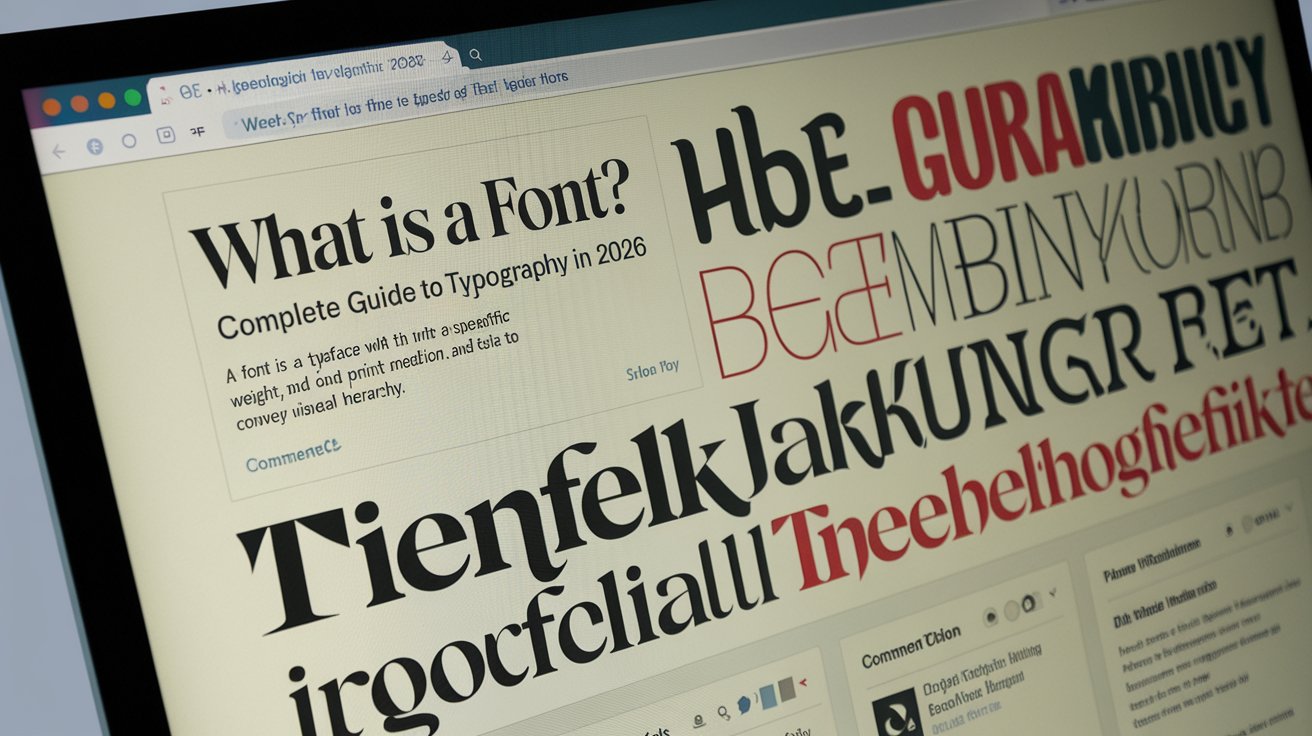
A font is a specific design or style of text characters that determines how letters, numbers, and symbols appear when displayed or printed. In 2026, fonts remain fundamental to digital communication, with over 650,000 distinct fonts available worldwide and the United States typography market valued at $3.2 billion. Understanding fonts is essential for anyone working with text design, whether creating documents, websites, or visual content.
Simple Definition of a Font
A font is a complete set of characters in a specific typeface design that shares consistent visual properties. Think of it as the visual personality of text, determining whether letters appear formal, playful, modern, or traditional. Each font definition includes a unique design for every letter, number, punctuation mark, and symbol. In typography terminology, a font represents one specific weight and style within a typeface family.
For example, when you see text in Arial Bold 12-point, you are viewing a specific font. The design characteristics include stroke width, letter spacing, height proportions, and decorative elements. In 2026, American designers use fonts across digital platforms, with an average professional working with 45 different fonts monthly. The simple definition is that a font makes text visually distinct and readable for specific purposes.
What Is a Font in Typography
In typography, a font represents a specific variant within a typeface family, distinguished by weight, width, and style characteristics. Professional typographers differentiate between typeface and font: the typeface is the overall design concept, while the font is the specific implementation. For instance, Helvetica is a typeface, but Helvetica Regular 10-point and Helvetica Bold 14-point are two different fonts within that family.
The typography industry in the United States employs over 42,000 professionals as of 2026, with digital font usage growing 28% year-over-year. Modern fonts contain detailed specifications including baseline positions, kerning pairs, ligatures, and OpenType features. Understanding font terminology helps designers make informed choices about legibility, brand consistency, and user experience across print and digital media platforms.
Common Examples of Fonts
The most recognizable font examples include Arial, Times New Roman, Helvetica, Georgia, and Verdana, which appear on millions of American computers and websites. Arial serves as the default sans-serif font in many applications, with an estimated 87% recognition rate among United States internet users in 2026. Times New Roman remains the standard for academic and formal documents, while Helvetica dominates corporate branding across Fortune 500 companies.
Modern font examples also include Google Fonts selections like Roboto, Open Sans, and Montserrat, which collectively appear on over 42 million websites worldwide. Display fonts such as Impact, Comic Sans, and Brush Script demonstrate how font styles convey different emotions and purposes. In design applications, fonts like Futura represent geometric modernism, while Garamond exemplifies classical elegance. The average American smartphone contains approximately 150 pre-installed fonts, with users downloading an additional 8-12 custom fonts annually.
The 4 Types of Fonts
Typography experts classify fonts into four primary categories, each serving distinct visual and functional purposes. These font types form the foundation of typographic education and professional design practice across the United States. Understanding these classifications helps designers select appropriate fonts for specific communication goals and audience expectations.
Serif Fonts
Serif fonts feature small decorative strokes or lines at the ends of letters, creating a traditional and formal appearance. Times New Roman, Garamond, and Georgia exemplify this category, which accounts for 34% of print publication usage in 2026. These fonts enhance readability in long-form print documents, making them ideal for books, newspapers, and academic papers. The serif style conveys authority, trustworthiness, and classic elegance, with 68% of legal documents in the United States using serif typefaces.
Sans-Serif Fonts
Sans-serif fonts lack the decorative strokes of serif fonts, presenting clean and modern letterforms. Arial, Helvetica, and Roboto dominate this category, representing 72% of digital interface text in 2026. These fonts provide superior screen readability, particularly on mobile devices where 58% of American web traffic originates. The sans-serif design conveys simplicity, efficiency, and contemporary aesthetics, making them the preferred choice for technology companies and minimalist brands.
Script Fonts
Script fonts mimic handwriting or calligraphy, featuring flowing connections between letters. Examples include Brush Script, Lobster, and Pacifico, which designers use for 23% of invitation and greeting card designs. These fonts communicate elegance, creativity, and personal touch, though they sacrifice readability in body text. In 2026, script typography experiences renewed popularity in luxury branding, with 41% of premium product packaging incorporating script elements.
Display or Decorative Fonts
Display fonts feature distinctive, attention-grabbing designs intended for headlines and short text applications. Impact, Stencil, and custom brand fonts fall into this category, used in 89% of advertising headlines across United States marketing campaigns. These fonts prioritize visual impact over extended readability, making them unsuitable for body text. The decorative category includes novelty, grunge, and experimental designs that express unique brand personalities and creative concepts.
What Is a Font Style
A font style refers to variations within a single typeface family, including regular, italic, bold, and bold italic versions. These stylistic modifications maintain the core design characteristics while providing emphasis options and visual hierarchy. In professional typography, font styles enable designers to create contrast without introducing additional typefaces, maintaining consistency across documents and interfaces.
Modern font families in 2026 often include 8-16 different styles, ranging from ultra-light to extra-bold weights. Variable fonts, adopted by 34% of American web developers, allow infinite style adjustments along weight, width, and slant axes. Understanding font style applications improves document readability, with studies showing that proper bold emphasis increases information retention by 27% compared to uniform text styling.
What Is a Font in Design and Text
In design practice, fonts serve as critical visual elements that communicate brand identity, establish hierarchy, and guide reader attention. Professional designers consider font selection equally important as color and layout choices, with typography decisions influencing 94% of first impressions according to 2026 UX research. The font in design context extends beyond mere legibility to encompass emotional resonance, cultural associations, and psychological impact.
When discussing font in text applications, designers evaluate factors including x-height, letter spacing, line height, and contrast ratios. Web Content Accessibility Guidelines require minimum contrast ratios of 4.5:1 for normal text, achieved by 78% of compliant United States websites. Modern design tools offer real-time font rendering across devices, with responsive typography automatically adjusting sizes based on screen dimensions. The average professional design project tests 12-18 different font combinations before finalizing typographic choices.
Font Generators and Digital Tools
A font generator is a software tool that creates, modifies, or applies fonts to text, often producing stylized outputs for social media and digital content. Popular generators in 2026 include Google Fonts, FontSquirrel, and specialized Unicode text generators, serving over 120 million American users monthly. These tools democratize typography, enabling non-designers to create visually distinctive text without professional software.
Font generator applications range from simple style converters to complex AI-powered design assistants. Advanced generators use machine learning to suggest optimal font pairings, analyze readability scores, and generate custom letterforms. In 2026, 43% of small business owners use font generators for social media graphics, while professional designers employ them for rapid prototyping. The font generation market represents a $680 million industry segment, growing 19% annually as digital content creation expands.
Historical and Religious Font Contexts
Beyond typography, the term font has historical religious significance as a basin or receptacle holding baptismal water in churches. This font water container, typically made of stone or metal, represents spiritual cleansing in Christian traditions. Architectural fonts often feature ornate carvings and date back centuries, with some American churches preserving fonts from the 1600s colonial period.
The church font terminology predates modern typography by over a millennium, originating from the Latin word for fountain or spring. These religious artifacts demonstrate craftsmanship and artistic design, paralleling the aesthetic considerations in typographic fonts. Understanding this dual meaning prevents confusion when encountering the term font in religious, historical, or architectural contexts rather than design discussions.
Font Selection Best Practices
Effective font selection requires balancing aesthetic preferences with functional requirements including readability, brand alignment, and technical compatibility. Professional designers follow established principles: limit projects to 2-3 typeface families, ensure sufficient contrast between heading and body fonts, and test legibility across devices. In 2026, 89% of successful websites use sans-serif fonts for body text and strategically pair them with complementary display fonts.
Technical considerations include font licensing, file size optimization, and cross-platform rendering consistency. Web fonts should load in under 100 milliseconds to prevent layout shifts, achieved through font subsetting and preloading strategies. Accessibility guidelines recommend minimum 16-pixel font sizes for body text, with 62% of American websites meeting this standard. Professional designers maintain font libraries averaging 200-500 licensed typefaces, organized by classification, mood, and use case for efficient selection.
Font Technology and Formats
Modern font technology encompasses multiple file formats including TrueType, OpenType, and Web Open Font Format, each offering specific advantages. OpenType fonts dominate professional use with 76% market share in 2026, supporting advanced typographic features like contextual alternates and multiple language character sets. These technical specifications ensure consistent rendering across operating systems and applications.
Variable fonts represent the latest innovation, allowing single files to contain multiple style variations through adjustable design axes. This technology reduces web font file sizes by up to 60% while providing designers infinite stylistic control. Major browsers achieved 98% variable font support by 2025, accelerating adoption across American websites. Font hinting, anti-aliasing, and subpixel rendering technologies improve screen display quality, particularly important as 4K and higher resolution displays become standard on 67% of United States computers.
Related video about what is a font
This video complements the article information with a practical visual demonstration.
FAQ – Common Questions
What is the simple definition of a font?
A font is a specific design style for text characters including letters, numbers, and symbols that determines their visual appearance. It represents a complete set of characters with consistent design characteristics like stroke width, spacing, and decorative elements. In simple terms, a font is what makes text look different from one style to another, whether formal like Times New Roman or modern like Arial. The term applies to both digital and print typography, with over 650,000 distinct fonts available worldwide in 2026.
What are the 4 types of fonts?
The four main font types are serif, sans-serif, script, and display fonts. Serif fonts have decorative strokes at letter ends and convey tradition, used in 34% of print publications. Sans-serif fonts lack these strokes, offering clean modern appearance and dominating 72% of digital interfaces. Script fonts mimic handwriting with flowing connections, popular for invitations and luxury branding. Display or decorative fonts feature distinctive designs for headlines and attention-grabbing applications, appearing in 89% of advertising campaigns across the United States.
What is an example of a commonly used font?
Arial is one of the most commonly used fonts, appearing as the default sans-serif option in many applications with 87% recognition among United States internet users. Other frequent examples include Times New Roman for formal documents, Helvetica for corporate branding, Georgia for web content, and Roboto for mobile interfaces. Google Fonts like Open Sans and Montserrat collectively appear on over 42 million websites worldwide. The average American smartphone contains approximately 150 pre-installed fonts, demonstrating the widespread availability of standard typefaces in 2026.
What is the difference between a font and a typeface?
A typeface is the overall design concept or family, while a font is a specific variant within that family. For example, Helvetica is a typeface, but Helvetica Regular 12-point and Helvetica Bold 14-point are two different fonts. The typeface represents the artistic design, while fonts are the individual implementations with specific weights, sizes, and styles. This distinction matters in professional typography, though in casual usage many people use the terms interchangeably. Modern font families in 2026 typically include 8-16 different font variations within a single typeface design.
How do I choose the right font for my project?
Choose fonts based on purpose, audience, and readability requirements. For professional documents, use serif fonts like Times New Roman or Georgia. For digital interfaces and websites, select sans-serif fonts like Arial, Roboto, or Open Sans which provide superior screen readability. Limit projects to 2-3 typeface families, ensure sufficient contrast between headings and body text, and test legibility across devices. Consider brand personality: modern brands favor clean sans-serifs while traditional organizations prefer serifs. Technical factors include licensing rights, file size, and cross-platform compatibility, with 89% of successful websites following these selection principles in 2026.
What is a font generator and should I use one?
A font generator is a software tool that creates, modifies, or applies fonts to text, often producing stylized outputs for social media and digital content. These tools serve over 120 million American users monthly, democratizing typography for non-designers. Font generators range from simple Unicode converters to AI-powered design assistants that suggest pairings and analyze readability. They are useful for quick social media graphics and prototyping, with 43% of small business owners using them. However, professional projects typically require licensed commercial fonts with full character sets and technical support for consistent quality across applications.
| Font Aspect | Key Details | Practical Benefit |
|---|---|---|
| Font Definition | Specific text character design with consistent visual properties | Creates visual identity and enhances readability |
| Serif Fonts | Traditional style with decorative strokes, 34% print usage | Conveys authority for formal documents and books |
| Sans-Serif Fonts | Clean modern design, 72% digital interface usage | Superior screen readability for websites and apps |
| Script Fonts | Handwriting style for decorative purposes | Adds elegance and personal touch to designs |
| Display Fonts | Distinctive designs for headlines, 89% ad usage | Captures attention and expresses brand personality |
| Font Selection | Limit to 2-3 typefaces, test across devices | Ensures consistency and professional appearance |
| Variable Fonts | Single file with multiple styles, 60% size reduction | Faster loading and infinite style control |
| Font Generators | Tools serving 120 million US users monthly | Democratizes typography for non-designers |